


Extragalactic Astronomy
 
 Associated Faculty and Web Pages listed below.

Members of the Department are heavily involved in a wide range of research in extragalactic astronomy.

Extragalactic Distance Scale. Chief among extragalactic research in the department is the determination of the extragalactic distance scale via a variety of techniques. These include observations of the expanding photospheres of Type II supernovae, supernovae of Type Ia, involvement in the HST Key project and other projects to measure Cepheid distances to nearby calibration galaxies, the determination of mass models for gravitational lenses combined with measurements of the time delay between different images, and the use of the infrared luminosity-line width relation to map the large scale velocity field of galaxies - necessary both for the determination of the Hubble Constant and for local large scale measurements of the mean mass density of the universe.

Galaxies and Galaxy Systems. Members of the Department are also leaders in the study of the internal dynamics of galaxies and the kinematics of galaxy systems, i.e., groups and clusters. They measure hot X-ray gas in galaxy coronae and in groups and clusters of galaxies, galaxy velocities, the velocities of satellites of galaxies such as globular clusters, and the velocities of stars in our own Milky Way's halo. Such studies not only provide measurements of the masses of these systems but also provide clues as to their ages and their formation and evolution. Numerical computations addressing galaxy formation, evolution and interactions are a major research effort in the department as well.

Gravitational Lensing. Gravitational lens systems are the subject of intensive research at the CfA. Detailed radio and optical observations are used to test models of the mass distribution of the lensing object and to model the magnification of light from the background object. The lenses can be, e.g., small jupiters, or galaxies, or galaxy clusters. In addition, photons travelling for a long distance towards us interact with the gravitational potential over large scales providing information about large scale structure. Lensing properties indicate the distribution and quantity of mass directly, complementing other measurements such as those of luminosity or velocities.

Gamma-ray Bursts, AGN and the High Redshift Universe. Members of the department are actively engaged in current and proposed studies of Gamma Ray Bursts as probes of the high redshift universe (Narayan, Loeb, Grindlay in links below). Studies of active galaxies and the X-ray/gamma-ray background are planned for deep surveys with Chandra and XMM as well as possible future hard X-ray survey missions (EXIST and Constellation X).

See also the closely related area of cosmology.

Associated Professors and Lecturers

L. Greenhill, J. Grindlay, L. Hernquist, J. Huchra, R. Kirshner, J. Lee , R. Narayan, A. Loeb, M. Lecar, G. Rybicki, D. Sasselov, I. Shapiro , C. Stubbs
Associated Web Pages
Full Sky Astrometric Mapping Explorer (FAME)
Hubble Space Telescope Key Project on the Extragalactic Distance Scale
AFOE: A Spectrograph for Precise Stellar Radial Velocity Measurements
DIRECT --Distance determination to nearby galaxies
Mid-Infrared Array Camera, MIRAC
SIRTF, Space Infrared Telescope Facility and IRAC, its Infrared Camera
SMA: The Smithsonian Submillimeter Wavelength Array
Redshifts in Nearby Rich Clusters
WAXS/WXFT: Wide field X-Ray telescope
CASTLe Survey (CfA-Arizona Space Telescope Lens Survey of gravitational lenses)
HST Medium Deep Survey
Constellation X, X-Ray mission
Associated Divisions
High Energy Astrophysics, Optical and Infrared, Radio and Geoastronomy, Theoretical Astrophysics


Back to Research Areas in Harvard University Department of Astronomy.


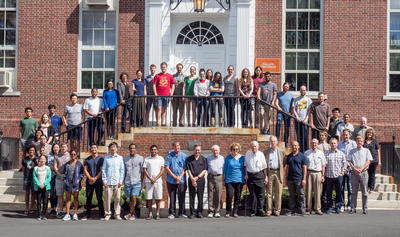
Section Photo