Contacts
|
CfA Home
|
HCO Home
|
SAO Home
|
Intranet
About
|
Research
|
Education & Outreach
|
Facilities
|
Opportunities
|
Events
|
Press Room
Resources for . . .
Scientists
Software Users
The Public
Educators & Students
Amateur Astronomers
CfA Staff (Intranet)
Scott's Home Page
Research
Planet Formation
Star Formation
Symbiotic Stars
Galaxies
Publications
Astro-ph
Journals
SAO Links
TAC
GMT
SSP Division
Terrestrial Planet Formation
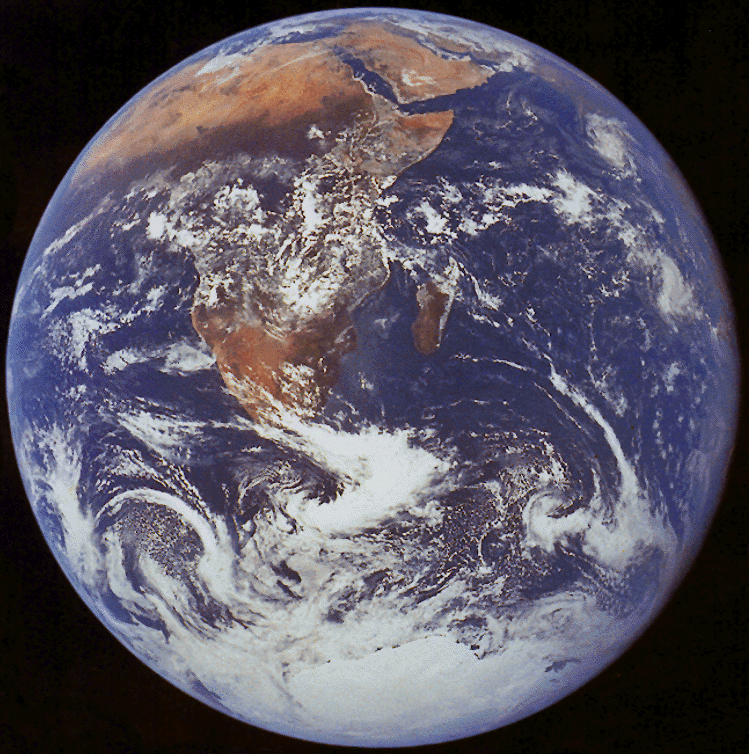
Terrestrial planets are rocky planets
Mercury, Venus, Earth, and Mars are mostly rock
Asteroids are rocky fragments of protoplanets
Terrestrial planets grow by accreting smaller objects
Disk-shaped nebula of dust and gas
Dust grains collide and merge
Large (1 mm) dust grains fall into a thin, dusty sheet
Collisions produce planetesimals 1 m to 1 km across
More collisions produce planets
Planets stir up the leftover planetesimals
Planetesimal then collide and fragment
A cascade of collisions reduces fragments to dust
Planets sweep up some of the dust
Radiation and a wind from the central star remove the rest
Computer calculations produce Earths in 1-10 Myr
Results for a
small simulation
without fragmentation
Results for a large simulation without fragmentation
Computer calculations produce lots of dust in 1-10 Myr
Results for a
small simulation
with fragmentation
Results for a large simulation without fragmentation
Observations can test these models
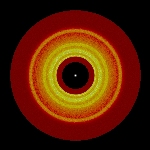
Dust from the collisional cascade is
observable
Dust geometry and luminosity can test the model
Debris disks are the dusty remains of planet formation.
Learn more ...
About
|
Research
|
Education & Outreach
|
Facilities
|
Opportunities
|
Events
|
Press Room
|
Contacts
|
Support CfA
|
Privacy
HARVARD-SMITHSONIAN CENTER FOR ASTROPHYSICS | 60 GARDEN STREET | CAMBRIDGE, MA 02138